Showing posts with label nonfiction. Show all posts

Tuesday, February 14, 2012

Meet Milton Doyle Gunderson III

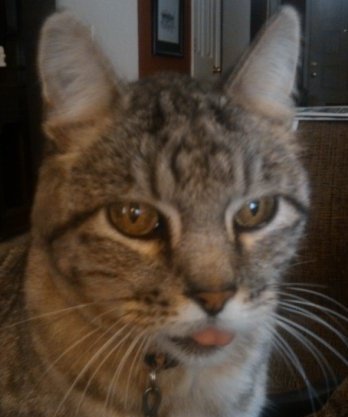
Our household is back at full strength with the addition of our new kitten: Milton Doyle Gunderson III.
This is Milton.

Milton is 9 weeks old, and his mother's name is Ralph. We don't know why.

Milton is small.

Milton plays a lot.


This is Milton's toy. His name is Danger Mouse.

Milton and Danger Mouse have many adventures.

Intrigue in the treacherous Caves of Sofa. Not pictured: Danger Mouse.

Some adventures get out of hand.

Milton administers CPR to Danger Mouse.

Most adventures are followed by a nap.

Zzzzzzzzzzzzzzzzzzzzzzzzzzzzzz.

###

Friday, January 27, 2012

My List of Names for a Female Cat

As our search for a new family cat continues, I have compiled a list of my favorite female cat names (although I have been known to name cats regardless of their gender).

My list of names for a female cat:

  • Lenore
  • Mary Martha Phillips
  • Weezie Jefferson
  • Jane Fonda
  • Jezebel Campbell-Smythe
  • Pussy Galore
  • Jackie C.
  • Annabelle Lee Gunderson
  • Diana Prince
  • Marvel Girl
  • She-Hulk
  • Nancy Drew
  • Eva Destruction
  • Frau Blucher 
  • Ebola Kachow Mahler


Thursday, January 26, 2012

My List of Names for a Male Cat

Our family is in the market for a new kitten. Having lost our long-time cat, Cecil Deuteronomy Johnson, in December, we are being very deliberate in finding just the right cat for us.

Haven't found it yet. But, I thought it was important to come up with a good name quickly, and so I present my list of favorite names for a male cat (female names will come tomorrow).

My List of Names for a Male Cat:

  • Jedediah Leviticus Smith
  • Yoda Malachi Jones
  • Frank Zappa
  • Thing 1
  • That Darn Cat
  • Milton
  • Tubal-Cain
  • Spot
  • Maxwell Dare
  • Idi Amin McGillicuddy
  • Zaphod Beeblebrox
  • LeRoy Habakkuk Nehemiah Anderson
  • Ringo Starr
  • Percy Ozmandias Wilkinson
  • Holden McGroin
  • Schuyler Colfax
  • Manu Tuiasosopo
  • Jabberwock Hughes
  • Ishmael Waldorf Simpson
  • Moby Dick Moench
###

Tuesday, January 24, 2012

I Haven’t Seen Any of the Oscar Pics, and Here’s Why


For the first time in my adult life, I have not seen any of the movies nominated for the Best Picture Oscar. This may say more about me than about the nominated films, but I’ll let you decide that.

In my callow youth, I remember making a pointed effort to see all five of the Best picture nominees. It wasn’t easy, but I tracked down a hole-in-the-wall theater that was still showing Atlantic City - which had been just nominated, along with Burt Lancaster for Best Actor. The movie made a great impression on me, and not only because Susan Sarandon showed her boobies.

One year I dutifully sat through Warren Beatty’s ego vehicle Reds, which I believe was three days long (with intermission).

I loved Amadeus. I hated Terms of Endearment. And on and on...

At some point, I realized that a movie could be nominated for an Oscar, and still be an unwatchable piece of crap. JFK, or the Crying Game, for example. I think the last Best Picture nominee I actually enjoyed watching was Ray in 2004. Inglourious Basterds was fun, but I still can’t believe it was nominated for anything. Little Miss Sunshine made me physically ill, and There Will Be Blood was utter nonsense.

Plus, we don’t go to that many movies in the theater anymore. I’ll wait for the DVD so I can watch it at home, where the popcorn is far less expensive and I know who sat in my seat before me. Does that makes me sound like an old fart? So be it.

Still, I was interested in the announcement of this year’s Oscars. Until I saw the list:

Hugo - This, apparently, is Martin Scorsese’s first cartoon...and it’s set in Paris. That’s all I know.

The Artist - A silent movie? Mel Brooks did this back in the 1970s. Big deal.

The Descendants - George Clooney makes this movie every year, and changes the title. Seriously.

Extremely Loud & Incredibly Close - A 9/11 movie with Tom Hanks? No thank you. I thought this was the title of another Nicholas Cage car theft/chase movie.

The Help - I have to admit I’ve heard of this one, and it’s the only one on the list that sounds interesting enough to watch. We’ll see.

Midnight in Paris - Is this not that nasty X-rated Marlon Brando movie from the early ‘70s? Oh, a Woody Allen movie? Even worse...

Moneyball - Based on a book by baseball stat geeks? How is that any more interesting than a probing look at the life of an insurance adjuster? Hey, no offense.

The Tree of Life - I heard that this Terrence Malick film is so unwatchable that audiences at screenings were angry enough to riot. But Malick could Flip video his dog taking a dump and the Academy would nominate it for Best Picture.

War Horse - Call me cold-hearted, but I don’t care about horses. Sea Biscuit...Secretariat...Black Beauty...Mr. Ed. I just don’t get it. I have as much feeling for horses as I do for goats - and I wouldn’t watch a movie about goats either.

That’s quite a list of movies that most people have never seen, and will never see (and I include the voting members of the Academy). War Horse will win going away, because it’s Spielberg.

As for me, I think I’ll rent Captain America again.

###

Thursday, December 29, 2011

Myron Roderick

I was sad to see that Oklahoma State wrestling legend Myron Roderick died. (Click here for an obit from the Oklahoman.) I had a chance to meet him while I was in college....
   It was early 1985, and I needed a story. As a journalism major at OSU, I found myself in a required, upper-level feature writing class, taught by Professor Harry Heath, the brilliant curmudgeon who had been the head of the whole journalism school at one time. After mulling over one mundane idea after another, I decided to write about the rebirth of the OSU football team.
   The Cowboys had just gone 10-2 in Pat Jones' first season, and everyone on campus was giddy about the football team. (It would be the early 1990s before everyone realized that Jones couldn't coach a lick.)
   I don't remember why, but I decided that I needed to interview Roderick, who was the athletic director at the time. Early one afternoon, I looked up the phone number for the athletic director's office and called it.
   Roderick answered the phone himself, catching me off-guard. After stammering around for a beat or two, I told him who I was, and what I wanted.
   "OK, I'm not real busy right now," he said. "Why don't you come by my office?"
   Try to imagine a major-college athletic director today doing something like that.
   I dashed across campus to the athletic offices, which were in the east end zone building attached to Lewis Field (what we now know as Boone Pickens Stadium). A secretary led me into a not-large office, and there was Myron Roderick, who smiled and shook my hand. Strong grip, not surprisingly.
   We talked for probably 45 minutes, about the football team, about the athletic department (and, like an idiot, I didn't ask him a single question about wrestling). I don't remember most of what he said, although I do recall him saying, in not so many words, that Jimmy Johnson was not the friendliest guy and that no one in the athletic department missed him. (Johnson left in the spring of 1984 to coach the University of Miami.)
   Then Roderick said, "Hey, you want to talk to Coach Jones?" And we were walking down a hallway to the football offices, where I spent about 30 minutes interviewing Pat Jones.
   Later, as I walked back to my dorm, I shook my head in amazement at how I had spent my afternoon. I wrote the story for my class over the next several nights, and I don't think I got a very good grade (Professor Heath was tough), but I didn't care. From that moment forward, I was a big fan of Myron Roderick.
   Everyone will remember his wrestling accomplishments, the NCAA titles, the fact that he hired Eddie Sutton. What I will remember is how he took the time to help a mostly-clueless journalism student with his homework.
###

Wednesday, December 21, 2011

What the Bell Ringer Saw...


  I spent last Saturday afternoon ringing a bell for the Salvation Army kettle drive. My son’s Boy Scout troop manned the kettle at a local Macy’s as their monthly service project, and my wife is the troop service project coordinator, so there was no way for me to worm out of it. As a result, I was able only to see the first half of the Baked Potato Bowl (or whatever that was on ESPN).
  You know all about the bell ringers. You see them every year, standing in front of nearly every store you visit. Hopefully, you drop a few coins in the kettle as you pass by. Sometimes you silently curse the incessant ringing (you know you do).
  When I donned that red Salvation Army apron and hefted that bell in my right hand, I became witness to all the faces of the Christmas season. I saw anger, stress, indifference and, perhaps surprisingly, lots of good cheer.
  There were the Avoiders - these people try not to make eye contact as they pass to enter the store:
  • Some look down at the ground;
  • Some will reach into their pockets and fumble around as if looking for change, only to pass on by;
  • Some pretend to talk on their cell phones.
  There were the Apologists:
  • “I just don’t have any money on me.”
  • “I put a bunch of money in a kettle yesterday.”
  There was the Candy Man, who walked up to me and held out a wrapped hard candy for me. With my left hand in my coat pocket, and my right hand ringing the bell, I smiled at the man and said, “No thank you.”
  The Candy Man gasped and took a step back, seemingly unable to believe that I had refused his piece of candy. “Don’t take candy from strangers” is good advice for adults too, I think. He stalked off in a huff, without putting anything in the kettle.
  An elderly Asian lady tried to convert my son to Buddhism. She handed him a card and then spoke to him in Japanese for what seemed like a really long time. Then she told him in English that she had given him a Buddhist blessing. He thanked her, and kept ringing his bell.
  A middle-aged man dropped a dollar into my kettle and then asked me if I knew Jesus Christ. Just as I was about to say, “Yeah, I think he’s working the kettle over at Wal-Mart,” my wife stepped in and had a nice conversation with the man. She knows me well.
  I’ll admit I had been dreading doing this. I know, I know. But standing all afternoon and not being able to get away from the ringing...the Baked Potato Bowl seemed awfully enticing.
  Then a funny thing happened - the smiles of the children were contagious. Children love to put money in the kettle, and they beg their parents for quarters, dollars, anything. Once I realized that, I began to ring the bell with more gusto. I even sang a little bit (but not too much, because I didn’t want to scare anyone).
  Here’s Christmas for you: A large family (mom, dad, 6 kids) emerged from Macy’s, a blur of packages, sacks, animated chatter and untied shoes. The dad was harried, focused on getting his brood to the car intact.
  And then, one of the children, a little boy maybe 6 years old, stopped. “I want a dollar!” he cried out. His father, clearly feeling the holiday stress, bellowed, “No!” and tried to keep walking. But now all 6 children had stopped. They looked at the shiny red kettle, and then at their father, who was now scowling. I thought we might have an ugly scene...
  ...Until the mom opened her purse, and the spirit of Christmas came spilling out of it, in the form of nickels, pennies, dimes, all manner of coins transferred to the sweaty hands of those 6 children, who grinned from ear to ear as they deposited their largesse in the kettle.
  “Merry Christmas!” I called out. The father stood silently, watching his family, and though his expression never changed, I pictured his heart growing a size or two like in the Dr. Seuss Grinch cartoon.
  At home, later in the evening, I felt like I could still hear the bell ringing. And I was glad.

###

Thursday, December 15, 2011

Cecil Deuteronomy Johnson: 1996-2011


Cecil chose us.

Over the years Jennifer and I have had cats that we picked out of a “free kittens” box and cats that we adopted, but Cecil was the only one who picked us. He took up residence in the hedges in front of our house in Yukon sometime in 1996, I think it was. We don’t really remember the exact date or year, which is why we could never remember exactly how old Cecil was.

Cecil was, more or less, feral. I could see him peek at me from the cover of the bushes, two great big eyes, always wide like he was scared. Then he would hide. This went on for most of a year, and I actually thought there was more than one gray striped cat living in the bushes. But it was only Cecil, growing up.

Later, Jennifer admitted that she had been feeding him secretly most of that year.

When we formally welcomed Cecil into the family, it consisted of four cats, Jennifer and me. William came along in 1999. Cecil got along with Jake, Elwood, Tara and Miss Kitty - and they grudgingly let him join their odd pack. Miss Kitty was his surrogate mother, teaching him important things like how to climb up on the roof, and which trash cans had the tastiest stuff.

I remember many nights when Jennifer and I returned home to find Cecil and Miss Kitty on the roof. Miss Kitty would sit regally atop our chimney, silhouetted against the night sky, while Cecil prowled around the edges of the flat roof over our kitchen.

Cecil always forgot how to get back down, and we would have to coax him to the back of the garage, where he could jump down easily. And then hide from us.

It was years before Cecil would let us pet him. I always said he was the most cautious cat who ever lived.

When William was born, Cecil took little notice at first. Being an outside cat, he had no idea what was going on in the house. But he did notice that his weird little herd of cats was dwindling. First Jake died, then Tara (who Cecil thought was pretty, resulting in a trip to the vet to get “fixed”). Then one morning Miss Kitty, Cecil’s surrogate mom, died. Our herd was down to 2 cats: Cecil and Elwood.

We moved to Oklahoma City in 2000, and there was no question that Cecil would accompany us. Trapping him in a cat carrier ensured that it would be another couple of years before he would let us get close enough to pet him.

Our first night in Oklahoma City, Cecil disappeared. I figured that he was trying to walk home to Yukon. Jennifer searched for him all over the block, and in the cemetery behind our house, crying, certain that Cecil was gone.

By suppertime Cecil was back. He always knew where his supper dish was.

When William was four, Elwood died, leaving Cecil as our only pet. Cecil lived in the garage, where he had a box, a heater and his food dish. You could pet him if he was in his box (mainly because he couldn’t get away).

Gradually, Cecil realized that petting was a pretty good deal, and he relaxed enough to adopt William as his Pet Boy. And from that day forward, Cecil slept on William’s bed and sat in his lap whenever possible. It was as if Cecil was making up for all the years he ran away and hid.

Cecil became Cecil Deuteronomy Johnson one day when William decided that all his stuffed animals needed last names. Cecil needed one too. I threw in the middle name, Deuteronomy, because I thought he needed a cool middle name.

Cecil made us smile. He was affectionate, he was entertaining, and he kept the house and yard pest-free. Here’s a list of some of the things he caught and ate:
  • Birds
  • Baby birds (his favorite)
  • Bunnies
  • Some poor kid’s hamster
  • Mice
He never caught a squirrel, and he never climbed a tree. He liked to have us rub his tummy, which we discovered was spotted, in contrast to the stripes on his topside. He liked breakfast cereal and milk, which he would then barf up on the floor.

He purred really loudly.

Almost two years ago, he started having occasional seizures. He stopped catching critters. He slowed down, gradually lost weight. He was mostly deaf, and didn't see well either. He never stopped purring.

Cecil passed away on December 19, 2011, leaving behind a very sad Pet Boy and family.

Cecil was the best, and we were unbelievably lucky to have him. We will miss him.

Cecil chose us. Thank you, Cecil.

Thursday, November 03, 2011

They Wore Short Shorts

Once upon a time, basketball players wore really short shorts. 

...That's the message you'll probably take away from this photo, which I dug out my archives on the eve of college basketball season.

But there's more to the story.

Fresh off a season of photographing Oklahoma State football from the sidelines, I decided to try my hand at basketball photography.

Dec. 10, 1987 was not just another home game for Oklahoma State. It was the home opener, and the debut of the newly-renovated Gallagher-Iba Arena. (Note to OSU fans: this was the refurbishment that spiffed up the old Gallagher Hall, but retained close to the original seating capacity. The massive overhaul came much later.)

The Cowboys were in the second season of Leonard Hamilton's tenure as head coach. It was Hamilton's first head coaching job after serving as a Kentucky assistant, and at that point in his career he could recruit...but that was about it.

Notable players on the 1987-1988 squad included talented drug flame-out Richard Dumas and future New York Knicks stalwart John Starks. Naturally, I didn't get a single good photo of either one of them.

The arena looked great, with shiny brass railings and new seats that were more comfortable than the old ones, but still afforded leg-room only to children and amputees.

With my trusty Minolta in hand, I grabbed a piece of floor along the baseline. I quickly learned that basketball photography would be more uncomfortable than football had been. That hardwood floor is brutal on the knees, and you really can't stand up during the game and move around. You're surrounded by other photographers, and you have to watch out for stray basketballs and players flinging themselves out of bounds.

I focused on the space in front of the basket, and hoped for the best. This photograph was the best I had at the end of the game -- which OSU won over Tulsa University, 66-65. It would also be my last basketball photograph until I became an actual sportswriter in 1990. I'll leave those stories for another day.

Even though it was a close contest, plenty of Cowboys got into the game. This photo features backup guard/forward Mike Peterson scoring one of two baskets he recorded in 9 minutes of action. Also in the photo are starting center Sylvester (Sly) Kincheon (#42) and backup center/oddity Alan Bannister (#43). Bannister was from England, and because he was taller than 7 feet OSU gave him a basketball scholarship. He was the most un-coordinated human being I've ever seen. I remember watching him walk across campus, thinking he looked like a marionette - his limbs seeming to be under someone else's control. He played basketball like that, too. Finally, that's Derrick Davis (#11) in the background, who I don't remember at all.

And yes, they all wore short shorts -- because we didn't know any better yet.

Friday, September 30, 2011

Everybody Polka!

Larry Hettinga's Little Czech Band featured
a dual-accordion attack.
As a one-time newspaper reporter/photographer in the 1980s, I loved taking pictures of polka bands. Great visuals: an assortment of musical instruments like accordions and tubas, some interesting characters (playing and dancing), and the slightly run-down settings of Czech Hall and Ernie's Polka Palace in rural Canadian County, Oklahoma.

Taking good pictures was tough, because the dance halls were usually pretty dark, and then my flash would pop and temporarily blind the musicians. (Which I thought was funny. They did not agree.) I also learned to watch out for the (usually) elderly dancers flailing around after one octogenarian couple nearly knocked me down.

These two photos came from an actual Polka Festival hosted by Ernie's Polka Palace in the late 1980s. I remember being shocked at the crowds, and all the out-of-state license plates in the parking lot. Polka is big in certain circles, apparently. The hardcore polka-ers (ists?) wore a lot of polyester and had special dancing shoes that they would not wear anywhere but the wooden dance floor.
Pete and the Polkatimers: Music-marketing synergy. 

Still, the bands themselves held the most fascination for me. Some had matching outfits (volume discount for Sans-A-Belt slacks in many cases), some wore awesome hats. The multi-generation bands were interesting. The band on the left had it all. Pete and the Polkatimers! There's a lot to see in this photo. These guys are rocking the matching outfits with Sans-A-Belts, and they're multi-generational. But it's their marketing savvy that kills.

"Happy Music for Happy People": How strong is that? Also note that they are selling postcards and vinyl records right there on the stage. Oh, and also Pete's old accordion is for sale. This band was a self-contained business unit, ready to dominate. I wonder whatever happened to them....

Full disclosure: I'm one-quarter Czech, and I can do the Chicken Dance (if my wife makes me).

###

Postscript: I don't remember if either of these photos were published. If you look closely at the upper left corner of the bottom photo, you can see that these guys chewed on it.

Thursday, September 08, 2011

Standing in the Way of Barry Sanders' March to Glory


Barry Sanders was a transcendent, once-in-a-lifetime football player. He won the Heisman Trophy and turned in the greatest rushing season in NCAA history, and followed that up with a Hall of Fame career with the Detroit Lions.

But in 1987, he was a backup tailback and kick returner for Oklahoma State.

That year's Cowboy squad finished 10-2 and were led by senior tailback Thurman Thomas, himself a future Hall of Famer. I had the great good fortune to score a sideline pass for the OSU home games that season from my employer, the El Reno Daily Tribune, which gave me my first opportunity to try sports photography (see previous post).

Saturday, September 03, 2011

No Flag on the Play

Back in 1987, I got to try my hand at sports photography for the first time. My newspaper, the El Reno Daily Tribune, had a sideline photo pass for Oklahoma State games, and that year I got to go. I think maybe I won a drawing.

I'd been shooting pictures on a regular basis as reporter/photographer, but that was mostly around town. Football, I quickly learned, was a whole different ballgame (pun intended).

1987 was a good year to cover Oklahoma State football. They finished 10-2 and won the Sun Bowl over West Virginia. The only blemishes on the record (and this will sound all too familiar to Cowboys fans) were losses to Oklahoma and Nebraska. That's how it was in the old Big 8 Conference. 

That OSU squad featured senior tailback Thurman Thomas, a future Hall of Famer, and a sophomore quarterback named Mike Gundy. Oh, and the backup tailback was a guy named Barry Sanders (more about him in a future post).

Monday, August 08, 2011

The Eerie Arrow


Back in my newspaper days I was always on the lookout for good subjects for photographs. As a reporter, I had a beat to cover (city hall), and there was always plenty of small town news to write. But good photos, or front-page "art" as we called it, could be hard to find (which is one reason why so many pictures of my cats made it into the paper).

I experimented with night-time photography occasionally, which was hard because other than my old Minolta, a tripod and some high-speed film, I had no special equipment.

One night as I hung out with some friends at a local tavern I heard a story that I thought might make an interesting picture. By this time I had learned to take with a grain of salt these "local legend" stories, many of them conceived by drunken teenagers years before and handed down to successive generations of drunken teenagers as fact.

Seems there was a "Devil Worshipers' Road" somewhere in central Canadian County, Oklahoma. And on this road, a monument had been erected at the scene of the devil worshipers' atrocities. Something like that.

But unlike many of these local legends, one of my friends claimed to have seen it himself, and he offered to take me there.

Good deal, I said. Let me go home and get my camera first.

We drove around for more than an hour on dusty, unpaved backroads halfway between El Reno and Yukon, looking for this thing. Evidently, the County Commissioners hadn't gotten around to erecting a "Devil Worshipers' Road" street sign.

I was ready to give up and go home, sometime after 1 a.m., when we spotted a glow on the horizon ahead. That's it, the driver shouted. As the car slowed we moved past a clump of trees, and a field revealed itself on the right side of the road.

The field was the size of two football fields laid side-by-side, bounded by the road (and a barbed wire fence) on one side and trees on the other three. In the center of the field stood an enormous arrow, pointing straight up. An old street light, mounted on a nearby utility pole, bathed the scene in a soft glow. 

I have to admit, it creeped me out a little bit.

We climbed through the fence and quietly crept around the arrow. Once we were standing in the field, we could see a gravel driveway leading to a house at the opposite end of the field. The arrow had a metal framework that was covered by fiberglass sheets. Four guy wires held the arrow in place.

Whatever this thing was, it lacked context. Had the owner built it and erected it here? What was its purpose? There was no evidence of "devil worship" around it - no dead goats, no pentagrams. But it was weird as hell.

I set up my tripod, screwed a cable-release into the camera's shutter button, and tried a series of shots with different f stops and apertures. We left for home without being detected, or sacrificed.

When I developed the film and printed a few of the shots, my editor was not impressed. Did I have the owner's name? No. Did I have an address? No. Did I have the story behind the arrow? Well, no. 

I tried to drive back there the next week, and could not find it in the light (and sobriety) of day. So I forgot about the pictures.

Years later, I found out that the arrow had once stood atop the Space Needle tower at the State Fairgrounds in Oklahoma City. Some guy bought it when they replaced it with a newer one, and he took the arrow home and set it up in his yard.

This is the first time this photo has appeared anywhere. If you click on it and look at it full sized, the creepiness factor increases. Besides the dust particles and scratches on the print, you can see a weird light effect in the upper left corner that I like to tell  people is a UFO.

###

Wednesday, August 03, 2011

Remembering My Dad on His Birthday

 My dad was a shutterbug. He loved cameras, he loved film, and he loved taking pictures of family activities - holidays, birthdays, vacations.
He took some great photos, and our family is very lucky that he was so diligent in recording so many great memories. But, as with any shutterbug, Dad was hardly ever in any of the photos himself.

Except at Christmas.

Every year, without fail, Dad got out his tripod, screwed on the Minolta and flash, and directed us to stand in front of the fireplace for the annual Family Photo. This was usually on Christmas Day afternoon, after we'd had a big dinner. For many years, there were grandparents there, sitting on the couch, watching the photo shoot.

It seemed, to my young mind, like taking this photo lasted for hours. We never got it in one "take." And it was tricky, because Dad would set the timer on his camera, press the shutter, then run over and get in position. It must have been funny to watch.

We always took multiple shots, because in those pre-digital days, you didn't know what you had until the pictures (or slides, in our case) came back from the Foto-Mat.

At one point we began including the family pets in the photo, which got more challenging as a cat, and then a hamster, joined the family dog. In the photo above, you can see that Tiger the cat is keeping a sharp eye on my sister Lisa's hamster (Freddy?). Sandy, the dog, had too much hair to be able to see either the cat or the hamster.

I'm glad Dad took these pictures, and I'm glad my Mom has begun scanning all the old 35mm slides my Dad took back then.

Happy Birthday, Dad. We miss you.

Postscript: My dad would have been 69 today; he died in 2006. Here are two previous remembrances:

Monday, August 01, 2011

Pig vs. Pig: The Standoff

It's no secret that I liked taking pictures of animals back in my newspaper days (see here and here, for starters). For one thing, they never called to complain if you spelled their names wrong in the captions....

The call came in on the police scanner next to my desk in the newsroom of the El Reno Daily Tribune: a large pig was loose on Foreman Road. I don't remember if they called it a 10-54. That would be livestock on the highway; this was more residential.

I grabbed my camera, got in my car and raced to the scene (this is the very definition of a "slow news day"). Foreman Road was on the north side of town, kind of on the edge, but dotted with small houses.

And, suddenly, there was the porcine assailant:

My city-boy analysis told me that it was, indeed, a pig. Fairly large. Covered with mud.

It must have escaped from a nearby farm, and was making its way down the road, stopping occasionally to scratch an ear on a nearby telephone pole.

I hopped out of the car and started snapping pictures, hopeful that something weird might happen. Maybe someone would come running out of their front door and chase the pig with a frying pan. Maybe a dog would chase the pig. Any of those things would be good.

What I got was (almost) pure gold.


As I followed the pig down Foreman Road, an El Reno Police cruiser rolled up and stopped just ahead of me. The officer was the one who had been called to respond to the 10-54 (or whatever). I could see that he was preparing to get out of the car, when he looked in his side mirror and saw me - and my camera.


I could see the indecision. He knew that if he got out of the car anywhere near that pig, I would take dozens of pictures. He knew there was a great chance that the caption (or headline!) in the paper might say something like "Pig vs. Pig." Maybe even a bacon reference. And you know what: he was not wrong. That's exactly what I was thinking at the time.

So the officer did the only thing he could do. He slowly drove away.


The pig was last seen headed west on Foreman Road. He remained "at-large."

Postscript: You're darn right we ran those photos...but my eminently wise editor resisted the temptation of the "Pig vs. Pig" headline.

Monday, July 18, 2011

Outstanding in My Field (of Fire)

Have you ever seen a big grass fire, up close? Waves of heat shimmer as you try to look across the burning expanse, obscuring far-off details that aren't already hidden by the smoke. The smell of charred grass gets in your nose, like someone spilled something on the charcoal in your backyard grill.

During my newspaper days there were a couple of big grass fires that I was sent out to cover. I didn't take any notes; there wasn't a lot of information available at the scene. Grass is on fire, and, maybe, other stuff. Take pictures!


I gained a lot of respect for the firefighters, of course. Fighting fires is dangerous work, and many of the men I spoke to told me that they feared grass fires more than any other kind. It was the wind, that abundant Oklahoma wind, that made fighting grass fires unpredictable. And dangerous. A crew could be in the middle of a field, pushing back the fire line, when a change in wind direction or intensity could leave them suddenly surrounded by flames.

As a novice reporter/photographer, I didn't know all that yet. My first lesson in the unpredictability of a grass fire came when I returned to my car after shooting photos for an hour. Arriving on the scene, I parked on the grass shoulder of the road. When I returned, the grass was blackened within 2 feet of my front bumper.

I'd like to say I learned my lesson right then, but a couple of years later my zeal for getting a great photo made me do something stupid.

We heard the call on the police scanner in the newsroom: a wheat field was on fire, out near the federal prison (I have a good prison story I'll save for another day). I grabbed my camera and headed to the scene, where I parked a respectful distance across the road from the blazing wheat field.

It was a large field, and all the firefighting action was out in the middle, several hundred yards from where I stood. So I hopped the fence and waded out into the shoulder high wheat, determined to get closer.

By the time I got close enough to start snapping pictures, the fire fighters in their brush pumper trucks had it under control. Suddenly, my right eye still at the camera's viewfinder, I remembered.

The wind.

I lowered the camera and looked around me. For a hundred yards all around me, I was surrounded by wheat stalks almost as tall as I was. If the wind had changed, if the fire wasn't quite under control, I could have been roasted before I could run back to the road.

Gulp.

One of the brush pumpers drove in my direction and made a slow turn. I could see it was from the prison. They let non-violent inmates serve as volunteer firefighters. I waved. One of them waved back. Then they squirted me with a hose, turned, and drove back to the prison gates. I stood there for a moment, decided I was grateful, and headed back to my car.

###

Postscript: I'm pretty sure none of the photos I shot in the wheat field came out. The photo above is from my first grass fire, the one that almost claimed my car. It ran on the front page of the El Reno Daily Tribune.

Thursday, July 14, 2011

Good Time Baseball: Adam 89er, and the One Sport They Played at All Sports Stadium

 "Bee-yuh!"
"Cold Bee-yuh!"
For many years, that loud refrain was the true voice of summer baseball in Oklahoma City. If you watched the Oklahoma City 89ers in the 1970s and 1980s, you knew who Adam 89er was.

Adam was the old guy who sold beer at All Sports Stadium. Every night he would push a cart filled with ice and "bee-yuh," back and forth on the walkway between the box seats and the upper reserved seats.

I got to watch him in action close up in the summer of 1979, when I got my first job: ballpark vendor.

I was 15 (underage) when I interviewed for the job with Mike Cox, who was the son of 89ers owner Patty Cox Hampton and in charge of concessions at the ballpark.

This was, I thought, the greatest job a guy my age could possibly have. Free admission to the ballpark. Every night.

Cool!

My primary job was to fill up wire racks with cups of Pepsi, and sell them in the stands. They had rigged a handle that opened six taps at once, so you could fill up an entire row of the rack at a time. Then you had to slap lids on all the cups, and try not to spill anything. Sticky work.

As I walked up and down the steps and aisles of the ballpark, I would rather timidly say, "Pepsi. Who wants Pepsi?" I was kind of shy, and I didn't holler like I should have, but I reasoned that anyone in the stands who could see me had to know what I was selling. In spite of myself, I sold a lot. Especially when my parents came to a game early in my career. Every time I walked by, my dad would order another drink; I knew he hated Pepsi.

I was too young to sell beer, but I watched and followed the beer vendors. They knew how to belt it out - Adam 89er was, however, in a class by himself. When Adam was selling "bee-yuh" everyone in the ballpark knew it. He was good natured, always joking with his customers, and he seemed very Yoda-esque.

One of the first lessons I learned was to never buy popcorn at All Sports Stadium. My first night on the job, they put me in a dank concession kitchen and had me pop popcorn during the entire ballgame. Being a lightly-attended Thursday night game, we sold very few boxes, so the boss had me scoop all the remaining popcorn into big black trashbags and store them in a walk-in freezer. Then the team went on a week-long road trip. First game back, they had me sell that now-stale popcorn in the stands. One guy threw his popcorn at me the next time I walked by his seat.

I tried to stick with Pepsi after that.

The team's marketing slogan in those days was "Good Time Baseball!" And it was a good time. All Sports Stadium was state of the art when it opened in 1962, and it was still a decent park, though a little down in the heels, the summer I worked there.

The named it All Sports Stadium, after Oklahoma City's All Sports Association, which had been instrumental in its development. Over the years the name became a kind of running joke; some even called it One Sports Stadium.

It was nothing fancy; a concrete bowl dug down into the side of a hill at the State Fairgrounds. The general admission sections featured wooden bleachers painted blue. The reserved seats were blue metal folding chairs.
But there was an awesome hill down the third base line, and every game it would be swarmed with kids running, playing, and rolling down it. There was no upper deck, no outfield seating.

The 89ers were the Triple A affiliate of the Philadelphia Phillies in those days, and while the Phillies were good, the 89ers rarely were. We did have some notable players come through during that period - Keith Moreland, Bob Dernier, Ryne Sandberg, Lonnie Smith, Julio Franco come to mind. Of that group, only Moreland and Smith were on the 1979 roster - a team managed by Lee Elia, who would go on to infamously manage the Chicago Cubs and insult all their fans.

The stands were rarely full, but there were a number of colorful "regulars," including a guy who would play a bugle until he got too drunk to pucker his lips.
I only recall one sellout during my summer at All Sports - the 89ers played the Phillies in a July exhibition game. It was a weekend afternoon game, with temperatures seemingly near the boiling point. There were so many people there that the mezzanine was practically impassable from the crowds in line at the antiquated concession stands. I would emerge from the concession area with a rack of Pepsis and sell them all before I walked 10 feet. I don't remember seeing any of the game.

It was a great job, but it was only a one summer gig. Years later, when I worked as a reporter/photographer for the nearby El Reno Daily Tribune, I went back to All Sports Stadium to do a feature on Adam 89er.

Adam met me at the ballpark one evening, a couple of hours before the game, and told me his life story. He played for the St. Louis Stars in the Negro Leagues briefly, and he met Babe Ruth. He told a lot of stories, some of which I'm pretty sure he made up. And he let me follow him around and take some pictures.

Walker was actually featured in the Oct. 8, 1985 edition of the Weekly World News as the "Offspring King." The article credited him with 16 daughters, 12 sons, 98 grandchildren, 41 great-grandchildren, and four great-great-grandchildren.

Clearly he did more with his time than sell beer.

When Oklahoma City's MAPS project funded a new downtown ballpark in the mid-1990s, All Sports Stadium closed. I visited it one last time, a couple of years later, when the American Cancer Society held a Relay for Life there. Grass had overgrown the infield dirt; huge weeds sprouted from the warning track. It was a dried out husk. All Sports Stadium was dead, and Adam 89er was long gone.

Before I left for the last time, I went to the top of the third base hill, yelled "bee-yuh" and rolled down it one last time.

Good Time Baseball.

###

Postscript: I took these photos to accompany a feature story I wrote for the Northwest News, a tabloid-format paper that the El Reno Tribune owned for a few years in the late 1980s in an effort to broaden their reach into northwest Oklahoma City. In the third photo, Adam 89er is accompanied by one of his many grandchildren.

Thursday, June 30, 2011

A National Primary: The Cure to Iowa and New Hampshire

I don’t like to argue politics, but this is an issue that’s been bugging me, and it’s really not a Democrat vs. Republican argument.

It’s time for a national primary to select our candidates for President of the United States. Think about the current system: a bunch of idiots in Iowa and New Hampshire basically control who we will be able to vote for in November. Is it fair to rest the nation’s future on how a candidate shakes someone’s hand in a cornfield, or how well they tip a coffee shop waitress? Are the people of Iowa and New Hampshire especially wise? Do their needs jibe with ours? I say no.

Presidential preference primaries were a 20th-century creation, an effort to give more of a voice to the common voter and stem the influence of party bosses. Methods might differ from state to state, but the end result was a slate of delegates to the national party conventions - where the party bosses could still make deals in smoke-filled rooms and nominate someone else.

Conventional wisdom in today’s presidential politics says that a candidate must do well in Iowa - or New Hampshire - to have a chance at that party’s nomination. Just think about that for a minute. How stupid! Why Iowa and New Hampshire? Why not South Dakota and Delaware? It makes no sense when you begin to question the current set-up.

None of this, mind you, is spelled out in the Constitution. The parties have been making and changing the process since the 1820s. Nothing about primaries, or conventions for that matter, is sacred. So let’s change it!

As with most things in modern society, the undue influence of money and media has warped the political process. Many would argue that without the primary system, the less-well-funded candidate doesn’t stand a chance to get his or her message to the voters. But does a candidate without a big war-chest stand a chance in the current system? Let’s not kid ourselves.

Here’s what we should do:

1. Let’s take the television money out of the equation. Paid political ads will only be allowed during a two-week period leading up to the national primary (and, later, the general election). Every qualifying candidate gets the same amount of commercial time. I think France does this. Direct mail, telephone banks and personal appearances are permissible before, during, and after that two-week period.

2. We need a qualifying standard for candidates to participate in the national primary. Do they need to qualify in all 50 states? I say no, because that would eliminate the less-well-funded candidate. What should that qualifying standard be? Maybe they should be required to take a test and undergo a background check, like many people do when they apply for real jobs.

3. Let’s set the voting date for the national primary some time in May; a different date for each party. You can only vote in the primary if you’re registered in that party. We’ll have nationally-televised “debates” with each of the qualifying candidates invited to participate. And if there are, say, 15 qualifying candidates? Fine. Pop an extra bag of popcorn and settle in.

4. Let’s hold a runoff for each party, if necessary, in August. If one candidate doesn’t get 50 percent of the primary vote, then we take the top 3 or 4 to a runoff. Many states do that now with local elections. We won’t need party conventions, because they have turned into bloated television commercials that no one watches anyway. A party nominee could run on his own platform, his own ideas and convictions, without being hamstrung by a party platform plank insisted on by a vocal minority.

5. Here’s the best part. Let’s say the Republicans don’t have a candidate who can get 50 percent of the primary or runoff vote; then the top 2 Republicans both wind up on the November election ballot. Same with the Democrats. We might have a November presidential election with four candidates from the two parties. Now you have crossover voting - Ds can vote for Rs, and vice versa. Alternatively, maybe those candidates team up as candidate-running mate. Maybe they each choose a running mate.

6. What about Independents? We would need a qualifying standard for them as well. Maybe we lump them, along with the odd qualifying third-party candidate, into a catch-all primary. Or maybe they have a different qualifying standard to participate in the general election.

The bottom line is that voters would have more choices than they do in the current system. Over time, this might even lead to the creation of a legitimate third or fourth party - or, best of all, maybe the current political parties would fade away.

We shouldn’t be afraid to change the current system. Who knows? Something good might happen.