Showing posts with label photography. Show all posts

Tuesday, February 14, 2012

Meet Milton Doyle Gunderson III

Our household is back at full strength with the addition of our new kitten: Milton Doyle Gunderson III.
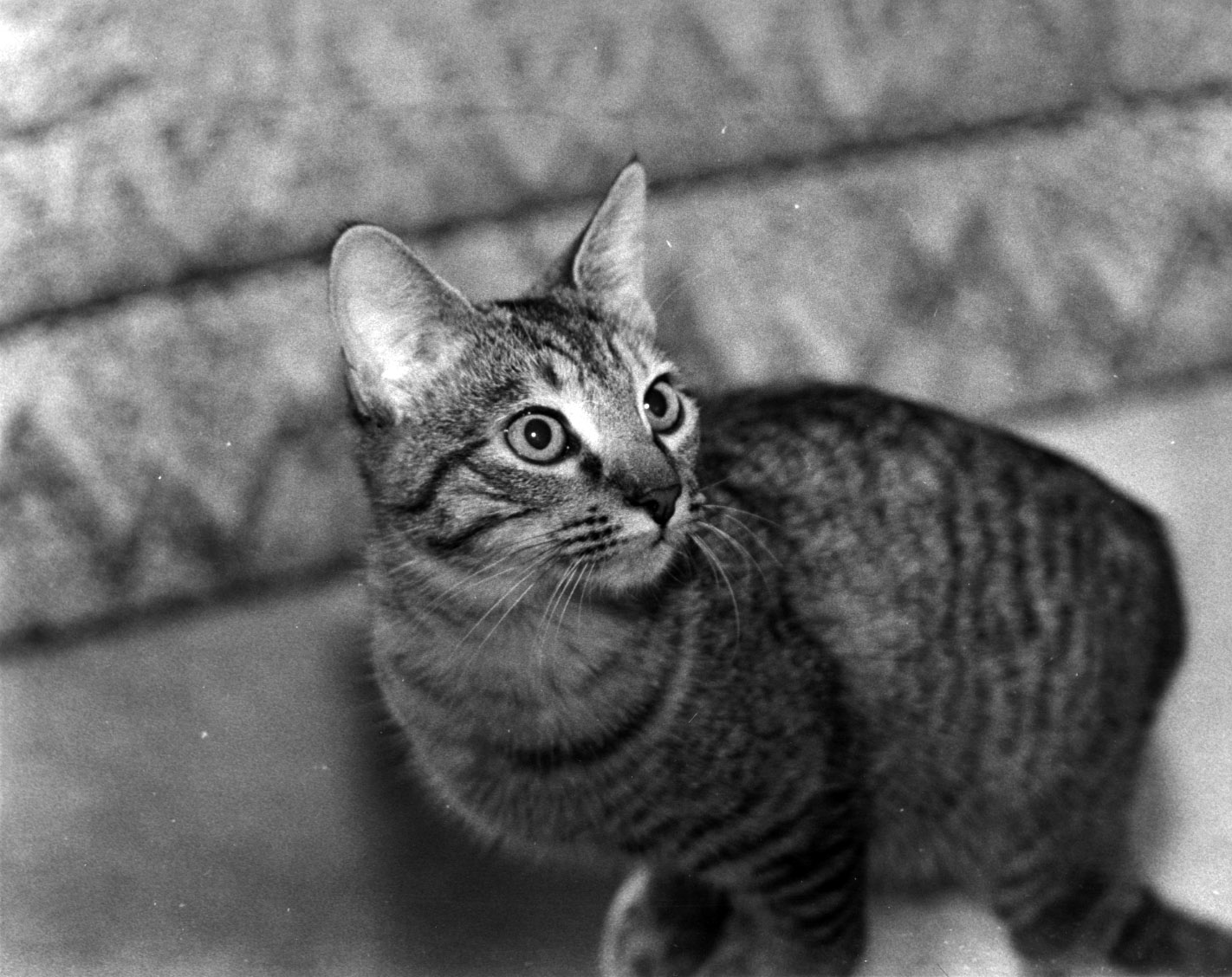
This is Milton.

Milton is 9 weeks old, and his mother's name is Ralph. We don't know why.

Milton is small.

Milton plays a lot.


This is Milton's toy. His name is Danger Mouse.

Milton and Danger Mouse have many adventures.

Intrigue in the treacherous Caves of Sofa. Not pictured: Danger Mouse.

Some adventures get out of hand.

Milton administers CPR to Danger Mouse.

Most adventures are followed by a nap.

Zzzzzzzzzzzzzzzzzzzzzzzzzzzzzz.

###

Thursday, November 03, 2011

They Wore Short Shorts

Once upon a time, basketball players wore really short shorts. 

...That's the message you'll probably take away from this photo, which I dug out my archives on the eve of college basketball season.

But there's more to the story.

Fresh off a season of photographing Oklahoma State football from the sidelines, I decided to try my hand at basketball photography.

Dec. 10, 1987 was not just another home game for Oklahoma State. It was the home opener, and the debut of the newly-renovated Gallagher-Iba Arena. (Note to OSU fans: this was the refurbishment that spiffed up the old Gallagher Hall, but retained close to the original seating capacity. The massive overhaul came much later.)

The Cowboys were in the second season of Leonard Hamilton's tenure as head coach. It was Hamilton's first head coaching job after serving as a Kentucky assistant, and at that point in his career he could recruit...but that was about it.

Notable players on the 1987-1988 squad included talented drug flame-out Richard Dumas and future New York Knicks stalwart John Starks. Naturally, I didn't get a single good photo of either one of them.

The arena looked great, with shiny brass railings and new seats that were more comfortable than the old ones, but still afforded leg-room only to children and amputees.

With my trusty Minolta in hand, I grabbed a piece of floor along the baseline. I quickly learned that basketball photography would be more uncomfortable than football had been. That hardwood floor is brutal on the knees, and you really can't stand up during the game and move around. You're surrounded by other photographers, and you have to watch out for stray basketballs and players flinging themselves out of bounds.

I focused on the space in front of the basket, and hoped for the best. This photograph was the best I had at the end of the game -- which OSU won over Tulsa University, 66-65. It would also be my last basketball photograph until I became an actual sportswriter in 1990. I'll leave those stories for another day.

Even though it was a close contest, plenty of Cowboys got into the game. This photo features backup guard/forward Mike Peterson scoring one of two baskets he recorded in 9 minutes of action. Also in the photo are starting center Sylvester (Sly) Kincheon (#42) and backup center/oddity Alan Bannister (#43). Bannister was from England, and because he was taller than 7 feet OSU gave him a basketball scholarship. He was the most un-coordinated human being I've ever seen. I remember watching him walk across campus, thinking he looked like a marionette - his limbs seeming to be under someone else's control. He played basketball like that, too. Finally, that's Derrick Davis (#11) in the background, who I don't remember at all.

And yes, they all wore short shorts -- because we didn't know any better yet.

Friday, September 30, 2011

Everybody Polka!

Larry Hettinga's Little Czech Band featured
a dual-accordion attack.
As a one-time newspaper reporter/photographer in the 1980s, I loved taking pictures of polka bands. Great visuals: an assortment of musical instruments like accordions and tubas, some interesting characters (playing and dancing), and the slightly run-down settings of Czech Hall and Ernie's Polka Palace in rural Canadian County, Oklahoma.

Taking good pictures was tough, because the dance halls were usually pretty dark, and then my flash would pop and temporarily blind the musicians. (Which I thought was funny. They did not agree.) I also learned to watch out for the (usually) elderly dancers flailing around after one octogenarian couple nearly knocked me down.

These two photos came from an actual Polka Festival hosted by Ernie's Polka Palace in the late 1980s. I remember being shocked at the crowds, and all the out-of-state license plates in the parking lot. Polka is big in certain circles, apparently. The hardcore polka-ers (ists?) wore a lot of polyester and had special dancing shoes that they would not wear anywhere but the wooden dance floor.
Pete and the Polkatimers: Music-marketing synergy. 

Still, the bands themselves held the most fascination for me. Some had matching outfits (volume discount for Sans-A-Belt slacks in many cases), some wore awesome hats. The multi-generation bands were interesting. The band on the left had it all. Pete and the Polkatimers! There's a lot to see in this photo. These guys are rocking the matching outfits with Sans-A-Belts, and they're multi-generational. But it's their marketing savvy that kills.

"Happy Music for Happy People": How strong is that? Also note that they are selling postcards and vinyl records right there on the stage. Oh, and also Pete's old accordion is for sale. This band was a self-contained business unit, ready to dominate. I wonder whatever happened to them....

Full disclosure: I'm one-quarter Czech, and I can do the Chicken Dance (if my wife makes me).

###

Postscript: I don't remember if either of these photos were published. If you look closely at the upper left corner of the bottom photo, you can see that these guys chewed on it.

Wednesday, September 21, 2011

We Made a Deal With the Clowns

Clowns indoctrinate a little girl, replacing her
brain with a paper chain.
It was a dark day in El Reno, the day the clowns came. At first, we attributed the rise in clown sightings on the circus, which had come through town the week before. You'd turn down an aisle in the grocery store and find yourself face to face with a clown - red ball nose, curly green hair, impossibly large shoes. The greasepaint on their faces would crack slightly when the smiled or yawned, and then you caught a glimpse of their fangs.
Family pets began to disappear, then the elderly. We didn't make the connection for weeks, and when we did, it was far too late.
   A clown moved into the apartment next to mine. Every night, as I returned home from work, the clown would stand in his open doorway, staring at me as I walked up the stairs. He never spoke (none of them did), but he would squeeze the bulb on his little horn and give me a honk as I went inside.
   People started attacking the clowns, trying to run them out of town. Turns out it's really hard to kill a clown. You can hit them, you can run them over with a car, you can fire them out of a cannon -- nothing. By the time we found out how to get rid of them, it was almost too late.
   As a reporter for the El Reno Daily Tribune, I covered the city government beat. I'll never forget the night I attended the City Council meeting and the Mayor was interrupted by the squeak-squeak-squeak of clowns marching into the council chambers. Someone told me later that he counted 20 clowns climbing out of a beat-up Ford Pinto that pulled up outside City Hall. They presented their list of demands to the mayor; it was written on a 200-foot long handkerchief that the Head Clown (who liked to be called Skeevy) pulled out of his pants pocket.
A little boy is transformed into a clown in front
of his horrified classmates.
   "We want your children," the list began. "Because no one will knowingly marry a clown, we must take children to replenish our numbers. We will select one girl, and one boy, from the elementary school once a week.
   "In return," the note concluded, "we will let you live." After the Mayor finished reading the demands, the clowns began honking their horns rapidly, in unison. All over town, the townspeople heard honking horns. There were hundreds, if not thousands, of clowns.
   We didn't know what else to do. So we made a deal with the clowns.
  Starting the next morning, clowns methodically examined all the children at the elementary school, and culled out two and took them away in front of their horrified classmates. Attendance plummeted.
   This went on for months. Eventually, clowns occupied 7 of the 9 city council seats, and they also took over the largest bank in town. A dull blanket of dread settled over El Reno, as clowns on unicycles raced back and forth on the streets at all hours.
   Our salvation came by accident. One afternoon a clown strode into the Texaco convenience store (squeak-squeak-squeak) to buy candy. They always bought lots of candy, paying with colorful pieces of paper that they insisted were as good as money. On this particular day, the clerk was playing a Michael Bolton CD. The clown cocked his head to one side, and his quizzical expression quickly transformed into a mask of pain. He opened his mouth and screamed silently, pink clown saliva glinting off his fangs. The clown pulled off his round red nose, and tried to stick it in his ear to silence the awful sound coming from the boom box on the counter. Where the nose had been, was now a gaping hole in the clown's face. Realizing too late what he had done, the clown tried to put his nose back. With a slight whooshing sound, his head caved in, and he fell to the floor, dead.
  Word spread fast. Michael Bolton CDs sold out at WalMart in 20 minutes, and soon the dreadful sound of his music was everywhere. Clowns died by the score.
   We managed to turn off the music before regular people started killing themselves. The horrible spell was broken, the town was saved. The clowns who weren't already dead quickly left town.
   Except for the clowns on the City Council. They served out the remainder of their terms.

###

Postscript: This is clearly not true. No children were harmed. But admit it: clowns are scary as hell, aren't they?

Thursday, September 08, 2011

Standing in the Way of Barry Sanders' March to Glory


Barry Sanders was a transcendent, once-in-a-lifetime football player. He won the Heisman Trophy and turned in the greatest rushing season in NCAA history, and followed that up with a Hall of Fame career with the Detroit Lions.

But in 1987, he was a backup tailback and kick returner for Oklahoma State.

That year's Cowboy squad finished 10-2 and were led by senior tailback Thurman Thomas, himself a future Hall of Famer. I had the great good fortune to score a sideline pass for the OSU home games that season from my employer, the El Reno Daily Tribune, which gave me my first opportunity to try sports photography (see previous post).

Saturday, September 03, 2011

No Flag on the Play

Back in 1987, I got to try my hand at sports photography for the first time. My newspaper, the El Reno Daily Tribune, had a sideline photo pass for Oklahoma State games, and that year I got to go. I think maybe I won a drawing.

I'd been shooting pictures on a regular basis as reporter/photographer, but that was mostly around town. Football, I quickly learned, was a whole different ballgame (pun intended).

1987 was a good year to cover Oklahoma State football. They finished 10-2 and won the Sun Bowl over West Virginia. The only blemishes on the record (and this will sound all too familiar to Cowboys fans) were losses to Oklahoma and Nebraska. That's how it was in the old Big 8 Conference. 

That OSU squad featured senior tailback Thurman Thomas, a future Hall of Famer, and a sophomore quarterback named Mike Gundy. Oh, and the backup tailback was a guy named Barry Sanders (more about him in a future post).

Monday, August 08, 2011

The Eerie Arrow


Back in my newspaper days I was always on the lookout for good subjects for photographs. As a reporter, I had a beat to cover (city hall), and there was always plenty of small town news to write. But good photos, or front-page "art" as we called it, could be hard to find (which is one reason why so many pictures of my cats made it into the paper).

I experimented with night-time photography occasionally, which was hard because other than my old Minolta, a tripod and some high-speed film, I had no special equipment.

One night as I hung out with some friends at a local tavern I heard a story that I thought might make an interesting picture. By this time I had learned to take with a grain of salt these "local legend" stories, many of them conceived by drunken teenagers years before and handed down to successive generations of drunken teenagers as fact.

Seems there was a "Devil Worshipers' Road" somewhere in central Canadian County, Oklahoma. And on this road, a monument had been erected at the scene of the devil worshipers' atrocities. Something like that.

But unlike many of these local legends, one of my friends claimed to have seen it himself, and he offered to take me there.

Good deal, I said. Let me go home and get my camera first.

We drove around for more than an hour on dusty, unpaved backroads halfway between El Reno and Yukon, looking for this thing. Evidently, the County Commissioners hadn't gotten around to erecting a "Devil Worshipers' Road" street sign.

I was ready to give up and go home, sometime after 1 a.m., when we spotted a glow on the horizon ahead. That's it, the driver shouted. As the car slowed we moved past a clump of trees, and a field revealed itself on the right side of the road.

The field was the size of two football fields laid side-by-side, bounded by the road (and a barbed wire fence) on one side and trees on the other three. In the center of the field stood an enormous arrow, pointing straight up. An old street light, mounted on a nearby utility pole, bathed the scene in a soft glow. 

I have to admit, it creeped me out a little bit.

We climbed through the fence and quietly crept around the arrow. Once we were standing in the field, we could see a gravel driveway leading to a house at the opposite end of the field. The arrow had a metal framework that was covered by fiberglass sheets. Four guy wires held the arrow in place.

Whatever this thing was, it lacked context. Had the owner built it and erected it here? What was its purpose? There was no evidence of "devil worship" around it - no dead goats, no pentagrams. But it was weird as hell.

I set up my tripod, screwed a cable-release into the camera's shutter button, and tried a series of shots with different f stops and apertures. We left for home without being detected, or sacrificed.

When I developed the film and printed a few of the shots, my editor was not impressed. Did I have the owner's name? No. Did I have an address? No. Did I have the story behind the arrow? Well, no. 

I tried to drive back there the next week, and could not find it in the light (and sobriety) of day. So I forgot about the pictures.

Years later, I found out that the arrow had once stood atop the Space Needle tower at the State Fairgrounds in Oklahoma City. Some guy bought it when they replaced it with a newer one, and he took the arrow home and set it up in his yard.

This is the first time this photo has appeared anywhere. If you click on it and look at it full sized, the creepiness factor increases. Besides the dust particles and scratches on the print, you can see a weird light effect in the upper left corner that I like to tell  people is a UFO.

###

Monday, August 01, 2011

Pig vs. Pig: The Standoff

It's no secret that I liked taking pictures of animals back in my newspaper days (see here and here, for starters). For one thing, they never called to complain if you spelled their names wrong in the captions....

The call came in on the police scanner next to my desk in the newsroom of the El Reno Daily Tribune: a large pig was loose on Foreman Road. I don't remember if they called it a 10-54. That would be livestock on the highway; this was more residential.

I grabbed my camera, got in my car and raced to the scene (this is the very definition of a "slow news day"). Foreman Road was on the north side of town, kind of on the edge, but dotted with small houses.

And, suddenly, there was the porcine assailant:

My city-boy analysis told me that it was, indeed, a pig. Fairly large. Covered with mud.

It must have escaped from a nearby farm, and was making its way down the road, stopping occasionally to scratch an ear on a nearby telephone pole.

I hopped out of the car and started snapping pictures, hopeful that something weird might happen. Maybe someone would come running out of their front door and chase the pig with a frying pan. Maybe a dog would chase the pig. Any of those things would be good.

What I got was (almost) pure gold.


As I followed the pig down Foreman Road, an El Reno Police cruiser rolled up and stopped just ahead of me. The officer was the one who had been called to respond to the 10-54 (or whatever). I could see that he was preparing to get out of the car, when he looked in his side mirror and saw me - and my camera.


I could see the indecision. He knew that if he got out of the car anywhere near that pig, I would take dozens of pictures. He knew there was a great chance that the caption (or headline!) in the paper might say something like "Pig vs. Pig." Maybe even a bacon reference. And you know what: he was not wrong. That's exactly what I was thinking at the time.

So the officer did the only thing he could do. He slowly drove away.


The pig was last seen headed west on Foreman Road. He remained "at-large."

Postscript: You're darn right we ran those photos...but my eminently wise editor resisted the temptation of the "Pig vs. Pig" headline.

Monday, July 18, 2011

Outstanding in My Field (of Fire)

Have you ever seen a big grass fire, up close? Waves of heat shimmer as you try to look across the burning expanse, obscuring far-off details that aren't already hidden by the smoke. The smell of charred grass gets in your nose, like someone spilled something on the charcoal in your backyard grill.

During my newspaper days there were a couple of big grass fires that I was sent out to cover. I didn't take any notes; there wasn't a lot of information available at the scene. Grass is on fire, and, maybe, other stuff. Take pictures!


I gained a lot of respect for the firefighters, of course. Fighting fires is dangerous work, and many of the men I spoke to told me that they feared grass fires more than any other kind. It was the wind, that abundant Oklahoma wind, that made fighting grass fires unpredictable. And dangerous. A crew could be in the middle of a field, pushing back the fire line, when a change in wind direction or intensity could leave them suddenly surrounded by flames.

As a novice reporter/photographer, I didn't know all that yet. My first lesson in the unpredictability of a grass fire came when I returned to my car after shooting photos for an hour. Arriving on the scene, I parked on the grass shoulder of the road. When I returned, the grass was blackened within 2 feet of my front bumper.

I'd like to say I learned my lesson right then, but a couple of years later my zeal for getting a great photo made me do something stupid.

We heard the call on the police scanner in the newsroom: a wheat field was on fire, out near the federal prison (I have a good prison story I'll save for another day). I grabbed my camera and headed to the scene, where I parked a respectful distance across the road from the blazing wheat field.

It was a large field, and all the firefighting action was out in the middle, several hundred yards from where I stood. So I hopped the fence and waded out into the shoulder high wheat, determined to get closer.

By the time I got close enough to start snapping pictures, the fire fighters in their brush pumper trucks had it under control. Suddenly, my right eye still at the camera's viewfinder, I remembered.

The wind.

I lowered the camera and looked around me. For a hundred yards all around me, I was surrounded by wheat stalks almost as tall as I was. If the wind had changed, if the fire wasn't quite under control, I could have been roasted before I could run back to the road.

Gulp.

One of the brush pumpers drove in my direction and made a slow turn. I could see it was from the prison. They let non-violent inmates serve as volunteer firefighters. I waved. One of them waved back. Then they squirted me with a hose, turned, and drove back to the prison gates. I stood there for a moment, decided I was grateful, and headed back to my car.

###

Postscript: I'm pretty sure none of the photos I shot in the wheat field came out. The photo above is from my first grass fire, the one that almost claimed my car. It ran on the front page of the El Reno Daily Tribune.

Thursday, July 14, 2011

Good Time Baseball: Adam 89er, and the One Sport They Played at All Sports Stadium

 "Bee-yuh!"
"Cold Bee-yuh!"
For many years, that loud refrain was the true voice of summer baseball in Oklahoma City. If you watched the Oklahoma City 89ers in the 1970s and 1980s, you knew who Adam 89er was.

Adam was the old guy who sold beer at All Sports Stadium. Every night he would push a cart filled with ice and "bee-yuh," back and forth on the walkway between the box seats and the upper reserved seats.

I got to watch him in action close up in the summer of 1979, when I got my first job: ballpark vendor.

I was 15 (underage) when I interviewed for the job with Mike Cox, who was the son of 89ers owner Patty Cox Hampton and in charge of concessions at the ballpark.

This was, I thought, the greatest job a guy my age could possibly have. Free admission to the ballpark. Every night.

Cool!

My primary job was to fill up wire racks with cups of Pepsi, and sell them in the stands. They had rigged a handle that opened six taps at once, so you could fill up an entire row of the rack at a time. Then you had to slap lids on all the cups, and try not to spill anything. Sticky work.

As I walked up and down the steps and aisles of the ballpark, I would rather timidly say, "Pepsi. Who wants Pepsi?" I was kind of shy, and I didn't holler like I should have, but I reasoned that anyone in the stands who could see me had to know what I was selling. In spite of myself, I sold a lot. Especially when my parents came to a game early in my career. Every time I walked by, my dad would order another drink; I knew he hated Pepsi.

I was too young to sell beer, but I watched and followed the beer vendors. They knew how to belt it out - Adam 89er was, however, in a class by himself. When Adam was selling "bee-yuh" everyone in the ballpark knew it. He was good natured, always joking with his customers, and he seemed very Yoda-esque.

One of the first lessons I learned was to never buy popcorn at All Sports Stadium. My first night on the job, they put me in a dank concession kitchen and had me pop popcorn during the entire ballgame. Being a lightly-attended Thursday night game, we sold very few boxes, so the boss had me scoop all the remaining popcorn into big black trashbags and store them in a walk-in freezer. Then the team went on a week-long road trip. First game back, they had me sell that now-stale popcorn in the stands. One guy threw his popcorn at me the next time I walked by his seat.

I tried to stick with Pepsi after that.

The team's marketing slogan in those days was "Good Time Baseball!" And it was a good time. All Sports Stadium was state of the art when it opened in 1962, and it was still a decent park, though a little down in the heels, the summer I worked there.

The named it All Sports Stadium, after Oklahoma City's All Sports Association, which had been instrumental in its development. Over the years the name became a kind of running joke; some even called it One Sports Stadium.

It was nothing fancy; a concrete bowl dug down into the side of a hill at the State Fairgrounds. The general admission sections featured wooden bleachers painted blue. The reserved seats were blue metal folding chairs.
But there was an awesome hill down the third base line, and every game it would be swarmed with kids running, playing, and rolling down it. There was no upper deck, no outfield seating.

The 89ers were the Triple A affiliate of the Philadelphia Phillies in those days, and while the Phillies were good, the 89ers rarely were. We did have some notable players come through during that period - Keith Moreland, Bob Dernier, Ryne Sandberg, Lonnie Smith, Julio Franco come to mind. Of that group, only Moreland and Smith were on the 1979 roster - a team managed by Lee Elia, who would go on to infamously manage the Chicago Cubs and insult all their fans.

The stands were rarely full, but there were a number of colorful "regulars," including a guy who would play a bugle until he got too drunk to pucker his lips.
I only recall one sellout during my summer at All Sports - the 89ers played the Phillies in a July exhibition game. It was a weekend afternoon game, with temperatures seemingly near the boiling point. There were so many people there that the mezzanine was practically impassable from the crowds in line at the antiquated concession stands. I would emerge from the concession area with a rack of Pepsis and sell them all before I walked 10 feet. I don't remember seeing any of the game.

It was a great job, but it was only a one summer gig. Years later, when I worked as a reporter/photographer for the nearby El Reno Daily Tribune, I went back to All Sports Stadium to do a feature on Adam 89er.

Adam met me at the ballpark one evening, a couple of hours before the game, and told me his life story. He played for the St. Louis Stars in the Negro Leagues briefly, and he met Babe Ruth. He told a lot of stories, some of which I'm pretty sure he made up. And he let me follow him around and take some pictures.

Walker was actually featured in the Oct. 8, 1985 edition of the Weekly World News as the "Offspring King." The article credited him with 16 daughters, 12 sons, 98 grandchildren, 41 great-grandchildren, and four great-great-grandchildren.

Clearly he did more with his time than sell beer.

When Oklahoma City's MAPS project funded a new downtown ballpark in the mid-1990s, All Sports Stadium closed. I visited it one last time, a couple of years later, when the American Cancer Society held a Relay for Life there. Grass had overgrown the infield dirt; huge weeds sprouted from the warning track. It was a dried out husk. All Sports Stadium was dead, and Adam 89er was long gone.

Before I left for the last time, I went to the top of the third base hill, yelled "bee-yuh" and rolled down it one last time.

Good Time Baseball.

###

Postscript: I took these photos to accompany a feature story I wrote for the Northwest News, a tabloid-format paper that the El Reno Tribune owned for a few years in the late 1980s in an effort to broaden their reach into northwest Oklahoma City. In the third photo, Adam 89er is accompanied by one of his many grandchildren.

Tuesday, June 14, 2011

Happy Flag Day

In honor of Flag Day, here's a photo I took in 2009 at the Oklahoma United Methodist Circle of Care's annual Boys Ranch Rodeo...

Sunday, June 12, 2011

Now There Was a Coach...

As I watch the field take shape for the College World Series, it's easy to see what this year's NCAA baseball championship tournament will have in common with the last 11: Oklahoma State is once again watching at home.
If you were an Oklahoma State baseball fan in the 1980s and early '90s, you thought it would last forever.
The conference titles. The College World Series appearances. The domination.

Sigh. Now look at them.

Under the leadership of the comatose Frank Anderson, the Cowboys have consistently squandered talent and underwhelmed their fans. Following a shocking Big 12 Tournament championship in his first season (2004), Anderson has managed to put more distance between the team and its glory years.

The Gary Ward Era
Gary Ward came to OSU in 1978 from the Arizona junior college circuit. He immediately transformed a moribund also-ran into the dominant baseball team in the old Big 8. The numbers speak for themselves:
  • 16 straight Big 8 championships 1981-1996
  • 13 Top Ten finishes in final Baseball America poll (since 1981)
  • 10 College World Series appearances.
  • 3 appearances in the national championship game.
  • 953 wins against 313 losses. Oh, and one tie.
The Cowboys never broke through and won the College World Series under Ward (the school's lone national title in baseball came in 1959), but they were always relevant. They were always right there. Any serious discussion of college baseball in the 1980s had to include Oklahoma State.

Ward taught the science of hitting, producing All-Americans like Robin Ventura and Pete Incaviglia. But more than that, he taught attitude. The Cowboys swaggered. They carried themselves like champions. Incaviglia would warm up in the on-deck circle by swinging a sledgehammer.

Nowhere was that attitude more in evidence than in the Big 8 Tournament, which the Cowboys owned for 16 consecutive years. In some years, it looked like the Cowboys run might come to an end, at the hands of the Oklahoma Sooners or an upstart Kansas team. But the Cowboys always came through in the end, staving off all challenges in the double-elimination tournament.

That success never translated fully to Omaha and the CWS. Ward's two best teams fell short in the final game to Stanford (and Jack McDowell) in 1987 and Georgia in 1990. Pitching usually let down the Cowboys in Omaha, and indeed, was always the team's Achilles' heel in the Ward era.

After making one last run to Omaha in 1996, Ward announced his retirement. He blamed a chronic back ailment, but in truth, lack of support from the OSU athletic department at the dawn of the Big 12 conference era pushed Ward out the door.

So naturally, they hired Tom Holliday, Ward's longtime pitching coach, to replace him. The same Holliday who was reponsible for the pitching that never measured up to the offense. Holliday made one trip to Omaha, and then was fired after seven mostly-underwhelming seasons.

The funny thing is, Holliday had more success than Frank Anderson. Anderson, however, soldiers on with the support of the athletic department. And Cowboy fans are left with memories of the days when they had a real baseball coach.

Postscript: I took this photo of Gary Ward during the Big 8 Tournament at old All Sports Stadium in Oklahoma City during the late 1980s. I believe he was threatening to make the shortstop walk home if he made another error (kidding). Baseball uniform buffs will note the sans-a-belt pants look, along with the pullover jersey. Those were great uniforms with "Oklahoma" in block lettering and "State" on the black baseball bat underneath. They frequently wore orange or black jerseys with the white pants. And black stirrups, by God.

Next time: More fun with black and white photography...

Thursday, June 09, 2011

The Case of the Missing Lips

El  Reno, Oklahoma was more exciting for a newspaper reporter than one might think. There was the bar fight that ended with a guy impaled by a broken pool cue...the wife-swapping/child sex ring...the bank failures...the armed robber we dubbed "The Tenderizer."

But what really got the locals excited in the late '80s was the time Channel 4 came to town to broadcast the news. It's a fairly common ratings stunt today, but I believe Channel 4 was the first Oklahoma City station to do it. For a week, they visited a different small town each day and broadcast the 10 p.m. news (and 6 p.m. too, I think). 
As a self-important young newspaper reporter, I looked down on the so-called journalists who worked in television. We who wrote for daily papers were the real deal, and the TV people were "personalities" and little more.
Let me give you an example of why we thought this way. 
In 1986, the nationwide savings and loan crisis was just budding, and El Reno turned out to be the scene of one of the very early bank failures. One afternoon, we got word in the newsroom that First National Bank of El Reno was about to be closed (the town's S&Ls failed the next year). This was big news - bank failures were the kind of thing we associated with the Great Depression, and now we had one in our own backyard!
I grabbed a camera and a notepad, and headed for the bank, which was only a block away from our office. Sure enough, the doors to the bank were locked, and a letter from the FDIC was posted, saying that the bank had been taken over by regulators.
As the news spread, people came and stood on the sidewalks. They thought they should be there to witness the spectacle (and nobody really knew what would happen). Soon, the TV newspeople from Oklahoma City arrived. No satellite trucks back then, just camera people and the on-air talent.
I stood in the alley behind the bank with the TV people, and a guy from the Oklahoman, for hours waiting for an announcement...or something from inside the bank.
Finally, at nearly 9 p.m., a bank-regulator-guy emerged from First National to make the official announcement. Due to a preponderance of bad loans, First National had failed, and its good assets were being sold to a bank from Lawton, Oklahoma. It would re-open the next day under the new name, blah blah blah. It was an important story, but a boring one.
We asked a few questions, and received canned, non-informative responses. Then, as the bank-regulator-guy was about to go back inside, one of the TV reporters spoke up.
"Uh, I was down the street having dinner and missed your announcement. Could you run through all that again?"
The TV reporter was, truly, a moron. And so I tarred them all with the same brush in my mind.
Fast forward to the next year, and the traveling circus that was Channel 4 came to town. People were very excited. At the newspaper, we chose not to interview the on-air talent. I mean, why would you?
I did, however, take pictures as they broadcast the 10 p.m. news from the Canadian County Historical Society museum. Located in the old train depot, the museum provided a great backdrop for the news - but the stage lights made the place unbearably hot.
In the picture above, co-anchors Jerry Adams and Linda Cavanaugh appear to have shown up on-set without their lips. But they have people for that, so it's OK.
Adams went on to piss away his career and was the subject of a few police mugshots. Cavanaugh is still the co-anchor at Channel 4. Who knows how many sets of lips she's gone through since that night in El Reno?
Postscript: I took this picture using natural lighting. They didn't allow me to use a flash during the broadcast.
Next time: Remembering a real baseball coach.

Monday, May 30, 2011

Jake & Elwood: Not Like Other Cats

I could have titled this "A Tale of Two Kitties," but that wouldn't have been edgy enough for this pair.

Jake and Elwood came in a box. Literally. A guy came by the office one day with a box of kittens he wanted to give away.
I didn't want a cat. I liked cats, but I was a single newspaper reporter working odd hours, and I figured I didn't need to be responsible for another life at that time.
"That's OK," the cat-man said. "Here, why don't you hold one for a minute?"
So I took two of them home with me that night. (Like that's never happened to you before...quit laughing.)
To me, the most important decision to make with these kittens was in the naming. They must have cool names. In fact, I have made that a priority with regard to all subsequent pets. I think cats respect you more if you give them a cool name.
The previous weekend, I had watched the Blues Brothers movie (again), and so, after briefly considering the names Sam and Dave, I dubbed the kittens Jake and Elwood.
I understood that it was also important to take them to the vet, for shots and whatnot, so we made that trip two days later.
"Son," the vet began, as he held Jake and peered at his underside, "these are girl-cats, not boy-cats."
Oh. I hadn't looked at their junk before I named them.
"You want to change their names?"
"No, I think I'll leave 'em Jake and Elwood. A name change might confuse them."
And so the adventures of Jake and Elwood began.
Jake F. (Female) Katt
Strong-willed. Charismatic. Innovative. They ran out of superlatives for Jake. He was the brains of the two-cat team. (You'll notice that I refer to Jake and Elwood as male throughout. Sue me.)
Jake was the alpha-cat, and while he made sure Elwood knew his place, he was fiercely protective of his brother.
I used to keep a small squirt bottle handy, and I would squirt the cats if they were doing something gross or evil.
One day that squirt bottle disappeared, and I never found it. Pretty sure Jake laughed about this behind my back.
Jake later served two terms in the Oklahoma Legislature, earning accolades for his common sense approach to government. He abandoned a bid for Governor when he found out that cats were not allowed in the Governor's mansion.
Blessed with the heart of a champion, Jake was let down by sub-standard kidneys. He died at age 7.
Elwood A. (Also-female) Katt
I knew Elwood was special the first night I brought him home. Elwood stood in the corner of my living room and meowed at the wall for about an hour before turning around and noticing the rest of the room. He'd been in that box a long time, I guess.
There are many stories like this about Elwood. The time he got lost under the bed. The time he got lost in the bathroom. The (many) times he couldn't find the litterbox. The time he caught a mouse but didn't know what to do with it (the mouse escaped, laughing hysterically).
Elwood followed Jake everywhere, no matter what the scheme. They ate a credit card I left on the counter. They chewed through the ground wire on my stereo turntable (yes, this is an old story).
I used to wake up in the middle of the night to find the two cats sitting on the bed, side by side, staring at me. Try to go back to sleep after that...

Blessed with none of the superlatives bestowed on Jake, Elwood nevertheless had good kidneys. He lived to be 10, and found his true purpose in life when William was born.

Postscript: In my constant search for front-page "art" for the El Reno Daily Tribune, I took the above black-and-white photos of Jake and Elwood. They both appeared on the front page of separate editions. This angered the publisher enough that she banned future use of staff members' pets as "art."

Next time: The Case of the Missing Lips

Friday, May 27, 2011

Iggy the Wonder Llama


This is my old friend Iggy the Wonder Llama. I took his picture back in the 1980s when I worked as a reporter/photographer for the El Reno Daily Tribune.

You may wonder about the color - or the lack thereof. Yes, boys and girls, we worked in black and white in those days. Not only that, we used real cameras that exposed images on film, which we then took back to a darkroom and processed and made into prints.

Right now you're saying to yourself, "This photograph isn't even that good."

And you're right. It's not my best work. It's a little out of focus, and the contrast could be better. But I defy you to get this close to a llama, point a camera at him, and see how you do.

Because Iggy was nasty.

You've probably heard that llamas spit. They do. They also bite, and they'll stomp you if they get a chance.

I met Iggy and his friends one summer afternoon as I cruised around El Reno looking for front page "art." That was part of each reporter's job - to take a camera (whether you knew how to use one or not) and find good pictures to put in the newspaper. We didn't have a staff photographer.

Fortunately, I took a photography class at Oklahoma State, so I at least knew which end to look through.

As I drove down a residential street that afternoon, I noticed a house with a chain-link fence and a group of rather unusual bushes in the backyard. These bushes looked like dark clumps of moss, low to the ground, each with a single, bare stalk rising from its center. I had never seen bushes like these before.

Then one of them stood up.

Ha ha! Not bushes, city boy! Ostriches!

Six ostriches in the middle of El Reno. Not something I expected to see. I made a quick u-turn in the middle of the street, and parked in front of the ostrich house.

After ringing the doorbell, I introduced myself to the owner of the house, and asked him if I could come in the backyard and take some pictures of his ostriches.

"Well, OK," the man said. "But I better go back there with you. Do you have a zoom lens?"

I did not. Not that day.

"Oh. Well, I wouldn't get too close to 'em if I was you. They might snap at you."

I'll be careful, I replied.

"OK then. I'll try to hold back the other animals while you're taking pictures."

Other animals?

I followed the man through the gate, and all six ostriches quickly go to their feet and began running around the yard. They were moving too fast for me to get a good shot.

That's when I heard a kind of grunting and hissing sound. I turned, and there was Iggy.

Click. Got him.

Figuring that I had at least one usable photograph, I relaxed and began to look around the yard.

Six ostriches.

Iggy.

Two peacocks.

Something was rubbing my leg. I looked down to see a brown calf rubbing his head against my leg - and smearing something dark brown across my khakis.

Nice.

I asked the man why he had so many odd creatures in his yard.

"I just like 'em," he said. "And the neighbors don't mind."

Postscript: Iggy the Wonder Llama was featured on the front page of the El Reno Daily Tribune the next day. The photo hung on the darkroom wall until I moved on to my next job three years later.

Next time: What happens when you give your girl cats boy names?